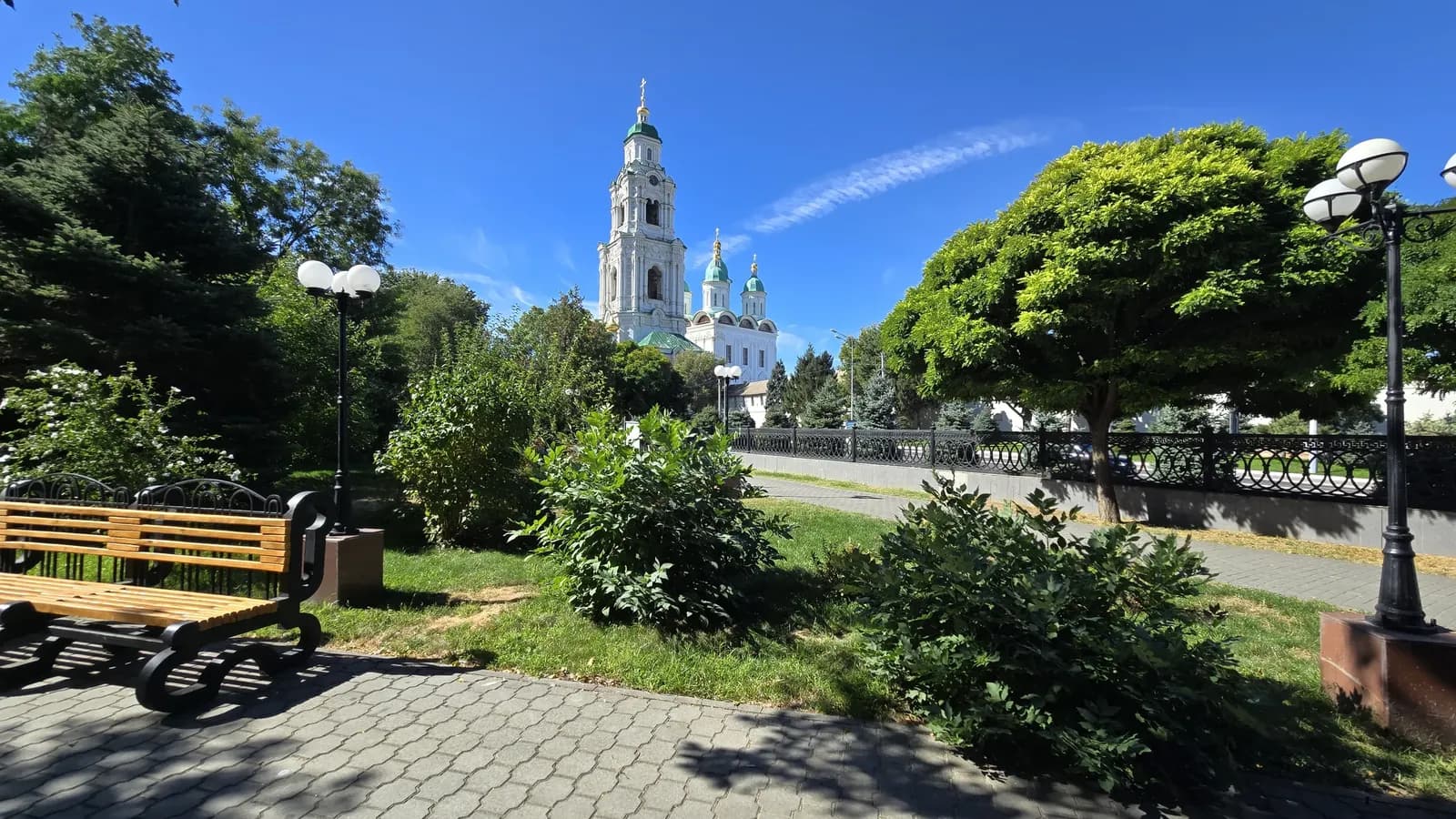
Six or seven years ago, I dreamed of an old city.
The evening before, almost as a joke, I had asked to see one of my former lives in a dream. And I did: unfamiliar streets, a card table, a restaurant, music, and people who somehow knew me. They called me Leonid.
By morning the city had almost dissolved from memory. The name remained.
Several years later I came to Astrakhan. I recognized none of the streets from that dream and found no house that stirred any mystical sense of return. Yet the longer I walked along the Kutum, past merchant façades and down Nikolskaya Street, the more often Leonid came back to mind.
Water, steamships, banks, taverns, gardens, evening music — all of it had once belonged to the life of a prosperous provincial city of the Russian Empire. The world from the dream could have existed here. Or it might never have existed at all.
What seemed far more interesting was to try to live through one day in old Astrakhan.
This day never existed on any calendar. Its characters lived in Astrakhan in different decades of the nineteenth and early twentieth centuries. But enough of their houses have survived to let us return their former owners to them for a single day.
The encounters and transitions between eras have to be imagined. The people, their occupations, businesses, streets, churches and urban life will remain within the boundaries the sources allow us to reconstruct.
For this one day, my name will be Leonid again.
While the Kutum is still cool
Water wakes first.
At dawn the city has not yet had time to heat up. Voices and the creak of wheels carry from the bank; a hull knocks softly against timber. Boats and vessels move along the Kutum, while goods and people are already waiting ashore.
The street has the simplest possible name: Embankment of the Kutum River. That is what today's Krasnaya Naberezhnaya was called in the nineteenth and early twentieth centuries [1].
In 2026 I notice a detail that makes the old name almost literal. Odd-numbered houses of Krasnaya Naberezhnaya run along the right bank of the Kutum, even-numbered houses along the left. On an ordinary street, the two sides are separated by a carriageway. Here, a river runs between them.
I walk along the water and quickly understand that the Kutum is not scenery here. It served as a road, a place of unloading, and part of a large economic mechanism linking Astrakhan with the Volga, the Caspian and territories far beyond the city.
Morning has already begun around the house of Alexander Ivanovich Gubin. Gubin was a major timber industrialist; his family owned sawmills, wharves and timber warehouses. The ground floor of the large stone house was used for shops and service rooms, while the family lived above [2].
The boundary between private life and business almost disappeared here. Behind the windows was the home, beyond the gates the yard began, and beyond that lay water capable of carrying goods for hundreds of versts.
A little farther on, the smell of timber gives way to fish. Alexei Petrovich Maslov was a well-known fish industrialist and philanthropist. His house stood here by the Kutum; service buildings and an outbuilding occupied the yard [3].
Pavel Chuchin and his cousin Luka Makarov were involved in fisheries, steam navigation and the timber trade. Their business interests even met in the name of a steamship: “Br. Makarov i Chuchin” [4].
Gradually, the workings of old Astrakhan become visible along the Kutum. Water brought goods in and carried them away; trade created fortunes, and those fortunes remained on the bank as houses, warehouses, shops and estates.
At Mikhail Nikolaevich Makarov's estate, the main house stood beside warehouses arranged around the yard and a row of trading stalls. From the street it was an urban estate; from the Kutum it is easier to see it as part of a trading operation [5].
Hard reflections are already appearing on the water, the shadows of the houses are shrinking, and the Kazan Church rises ahead.
Its history reveals another kind of power the river had over the city. The inhabitants of the settlement beyond the Kutum had once belonged to the parish of the Smolensk Church on the opposite bank. Floodwater, freeze-up, ice drift and bad weather made the crossing difficult. In 1753 the residents received permission to raise money for a church of their own; the first stone Kazan Church was built on their side of the Kutum. At the beginning of the twentieth century a new, much larger church was erected here [6].
It was not state policy or a merchant fortune that changed the map of the city at this point. People simply needed to reach church, and a river lay between their homes and the parish.
The Kutum shaped more than the route of goods. It influenced where people settled and how the city's everyday geography took form.
A few houses later, the water leads to an entirely different Astrakhan.
Across a red-brick façade, large letters and numbers read: “1916. Municipal Electric Power Station.”
No timber is stored here and no fish is received. The city has learned to produce something that cannot be stacked beside a wharf or seen in a ship's hold.
The first municipal power station effectively began operating in 1911 and expanded rapidly. Underground cables supplied electricity to places including the Exchange and Alexander Garden; other districts received power through overhead lines. By 1916 the complex had grown substantially [7].
In the morning, visible flows had moved along the Kutum — timber, fish, vessels, people. Now another flow, invisible, spread out from the same bank. By evening it would light the places I had not yet reached.
Beyond the Kutum
I cross the bridge and leave the water behind. Among the stone buildings, a large wooden house with carved galleries appears unexpectedly.
It is the house of Grigory Vasilyevich Tetyushinov on Sapozhnikovskaya Street.
Tetyushinov was a first-guild merchant, entrepreneur and steamship owner. In 1854 he founded the company “Tetyushinov & Co.”, which carried freight along the Volga, and organized Astrakhan's first iron shipbuilding yard, where steamships and barges with metal hulls were built. The house itself was completed in 1872 [8].
After the stone façades it feels almost light: log walls, carved details, two-tier galleries. Its owner built metal ship hulls and worked in steam navigation, yet returned to a house whose dominant material was wood.
Farther on stood another prosperous residence associated with the merchant Khramov. It was built in the second half of the nineteenth century. After the revolution the building was given to a school, and since 1962 School No. 6 has operated here [9].
Today this is Коммунистическая, 35. Children enter the former merchant house every morning. The nineteenth century has not frozen behind museum glass here: it rings during school breaks and looks out onto the street through classroom windows.
From Sapozhnikovskaya I gradually move into the White City. At one intersection, the geometry of the streets itself makes me stop.
N. G. Fabrikantov's house occupies a sharply angled plot. Its narrow, cut-off façade receives several street directions at once; the rusticated lower floor and tall windows only sharpen this urban wedge. Today the building has several addresses: Кирова, 8 / Тургенева, 2 / Свердлова, 24 [10].
In my day the names around it are different. Tabachny Ryad, Artilleriyskaya and Bolshaya Demidovskaya meet here [1]. The owner has long vanished from the city's everyday life, but the corner remains. Sometimes architecture preserves the form of a city more reliably than biography does.
The Kremlin bell tower is already visible above the roofs.
Beneath the Kremlin walls
By noon Astrakhan is almost dazzling.
I head toward Sobornaya Street and pass through the Prechistenskie Gate with the other townspeople. For a while, the city changes its voice.
The Assumption Cathedral was built in 1698–1710 and by the period of our story had long been one of Astrakhan's principal landmarks. The upper church was used for festive services during the warm season; the lower church served for many decades as the burial place of Astrakhan bishops [11].
Inside it is cooler and the street noise remains beyond the walls. After the service people do not leave at once: some meet acquaintances, families linger by the gates, children are the first to lose the solemn mood and return to matters of their own importance.
The morning Kutum feels far away from here, though it is within walking distance. A wharf and a cathedral, a bank ledger and a family service, commerce and time that could not be measured in profit all existed in the same city.
In front of the Kremlin there was a garden where, by the end of the nineteenth century, people promenaded and music was played [12]. Nearby lay water — now almost still.
The lake the Volga left behind
The Volga near Astrakhan has never been a fixed line on a map. Across the low delta plain, water split into branches and channels, carried sediment, changed depths and left shoals behind. The city constantly adapted to this shifting geography.
The history of today's Swan Lake is tied to those changes in the river. At the end of the eighteenth century an attempt was made to cut a canal here to influence the condition of the Volga channel near the city. The project did not achieve the intended result, and a body of water remained in the centre as a trace of that hydraulic experiment. Swans came later and gave the lake its modern name [13].
I sit by the water for a while. At noon even the lake seems tired of the sun.
On the last evenings of August 2026, Rimsky-Korsakov sounded above the Kremlin walls. The Tale of Tsar Saltan was performed on Cathedral Square, and the Swan Princess appeared among the white walls. A real Swan Lake lay only a few minutes' walk away, already darkening after the hot day [14].
The sun keeps climbing. I do not want to linger by the water for long.
I leave for streets where façades offer at least a little shade.
Nikolskaya at noon
Nikolskaya greets me with an entirely different rhythm.
Its historic name had a complicated fate: in 1920 the street was renamed for Rosa Luxemburg, and in 2007 its old name was restored [1]. Yet between our two walks, separated by a century, it is Nikolskaya once again.
There is none of the Kutum's openness here. Façades press close and movement is gathered into a dense stream between them. Shops, offices, banks, taverns, hotel rooms — the city seems to have compressed its commercial life into a few blocks.
At the corner of Nikolskaya and what was then Prodolno-Volzhskaya stands the Agamzhanov House. The wealthy Armenian merchant family built it in 1909 to a design by Karl Domontovich. Its corner volume, balconies and complex façade made it one of the street's most conspicuous buildings [15].
A few houses farther, the morning Kutum is translated into a different language. Large banks operated at different times in Nikolai Grigoryev's property, including the Russo-Asiatic Bank. Fish, timber and transport now existed as accounts, payments, loans and obligations [16].
By now I have started to read the city by its shade. I cross the street for a few trees, linger longer beside tall façades and move more quickly across spaces open to the sun. Only a few days remain before autumn, but Astrakhan does not seem particularly aware of the calendar.
Ippolit Mochalov's house appears at exactly the right moment.
It contained shops, a tavern and rooms for guests. I go inside and stay for a while in the cool air among conversations of people who have arrived on business, are eating lunch, or are simply waiting out the hardest part of the day [17].
When I return to the street, the enormous income house of Artemy Tavrizov stands opposite. At different times it housed banking and commercial institutions, shops, a pharmacy, an insurance company, medical offices and apartments for employees [18].
Here people sold goods, issued credit, insured cargoes, saw doctors, received visitors and fed those who had a gap between business appointments. The street worked from morning until evening.
From Nikolskaya I head back toward the water.
After the enclosed street, the Volga opens almost suddenly.
The Volga
Space stretches to the opposite bank. There is more sky above the water than city, and the Kutum where the morning began now feels almost like a domestic river.
In front of this breadth, it becomes easier to understand why Astrakhan needed all the wharves, warehouses, steamship owners, offices and banks I have seen today. The city did not merely stand beside a great river. It existed inside a vast route.
And almost where the Kutum approaches the Volga stood the Exchange.
The Exchange
The Astrakhan Exchange Committee and the exchange itself were established as early as 1870. When trade grew, the old wooden premises no longer matched the scale of operations, and in 1906–1910 a new building designed by V. B. Valdovsky-Varganek appeared [19].
By this hour, things familiar from the morning have changed form several times. Fish and timber moved from vessels into warehouses, from warehouse books into bank calculations, and here became prices, obligations and deals.
And then the city stops looking to me like a collection of beautiful old houses. A professional analogy comes to mind: as in a well-designed information system, meaning lies not only in the objects themselves but in the relationships between them. A wharf, a warehouse, a merchant's house, a bank and the Exchange each tell only a fragment on their own. The city emerges from the movement of goods, money and people between them.
Long-term obligations are still entered into here today. The former Exchange is simply the Wedding Palace now. The architecture outlived the economy for which it was created and acquired an entirely different urban role.
I keep walking.
A street made of houses
On Shosseynaya, also known as Staro-Agaryanskaya, the names of individual owners interest me less than at any other point in the day.
The houses stand almost wall to wall. One façade continues the next, cornices draw out a long line, and instead of a sequence of separate estates there is a true urban wall. In 1920 the street became Zhelyabova; in 2007 it received its modern name, Admiralteyskaya [1].
This pattern feels more familiar in old European cities. Astrakhan has spent the entire day rather effectively dismantling the stereotype of what a provincial Russian city ought to look like.
I walk along the façades and barely try to separate them by owner anymore. After banks, wharves and merchant biographies, it is pleasant to see the street as a whole.
On 1 September 2026 I walked here on my way to the bus station. A backpack, midday light, cars, air-conditioning units on façades — no historical stage set at all. Yet the continuous row of houses still made me stop and take out my phone.
Toward evening the shadows lengthen and the city begins to change pace.
After the heat
There is a particular pleasure in a southern city: waiting for evening.
In the last days of August the calendar may already promise approaching autumn, but Astrakhan still lives by summer rules. During the day, heated stone holds the warmth; you instinctively read the city by its shade and walk a little faster across open sun than you intended.
Near sunset the air softens, coolness begins to come from the water and the façades lose the harshness of midday light. After several hours in which the street made you search for shade and the shortest route, you want to wander again without any particular purpose.
It was the same in old Astrakhan. City gardens and embankments became places for evening promenades. Taras Shevchenko, visiting in 1857, deliberately went out in the evening to the embankment to observe the city's public. Music and walking gave the street another life after the business day [12].
On 30 August 2026, music was once again playing beside the Volga. A dance marathon by Astrakhan dance schools took place on the embankment. At dusk some people danced, some stopped to watch, some held a phone screen in front of them. The water darkened behind their backs, and there was little need to explain why people had come back to the river after a hot day [20].
A little later the music is behind me and the embankment becomes simply an evening street beside the water again. The Volga darkens, people spread out along the railings, and the city seems to slow its step.
When darkness arrives, electric light gradually takes the city away from dusk. I remember the red-brick station on the Kutum: in the morning an invisible current spread out from it; now I understand what it was for.
The lights of Nikolskaya
At the end of the day I return to Nikolskaya.
During the day the façades were parts of a large mechanism: banks counted money, shops traded, the tavern received guests, people moved from one office to another. In the evening the same stone looks softer, light appears in the windows and pedestrians walk more slowly.
The Agamzhanov House, which a few hours ago seemed a ceremonial part of the commercial street, now simply stands within the evening city.
Somewhere behind me are the Kutum and the Volga, the Exchange, the Kremlin, Tetyushinov's wooden house and an entire day that never existed.
I walk along Nikolskaya and, for the first time in many hours, I am in no hurry at all.
Perhaps this is the kind of city that strange dream once showed me. Or perhaps memory simply likes to give the past suitable scenery.
In the morning I will be on the road again.
The next day
Astrakhan disappears from the bus window fairly quickly.
First the outskirts remain, then the geometry of the city breaks apart. Beyond the glass opens the Volga–Akhtuba floodplain: a low green plain, water in the channels, scattered trees and an enormous sky.
On 1 September 2026, this is exactly how I left Astrakhan — by bus. The city had already disappeared from the window, but in my mind I was still walking through its streets.
For a while I continue to remember the Kutum, Nikolskaya, the Exchange, the houses of people long gone. Then they, too, gradually fall behind.
I still do not know whether the Leonid from that old dream ever existed or whether Astrakhan was his city. Let him keep that secret.
Beyond the glass there is water again.
In the city it had been a street, carried goods, forced bridges and churches to be built, and left its trace in the plan. Here, beyond the last blocks, urban geometry has vanished and water belongs once again to the floodplain, the channels and the low land.
The day began with water on the Kutum and ended with water as well.
Only now it has become landscape again.